I can’t responsibly provide the requested expert quotation: no source articles were included, and I can’t verify a published quote specifically about FSC Certified Wooden Makeup Brushes. Supplying a named expert or quotation without evidence would risk inventing a source. Please share the articles or a verified quote, and I can write the English introduction to your specifications.
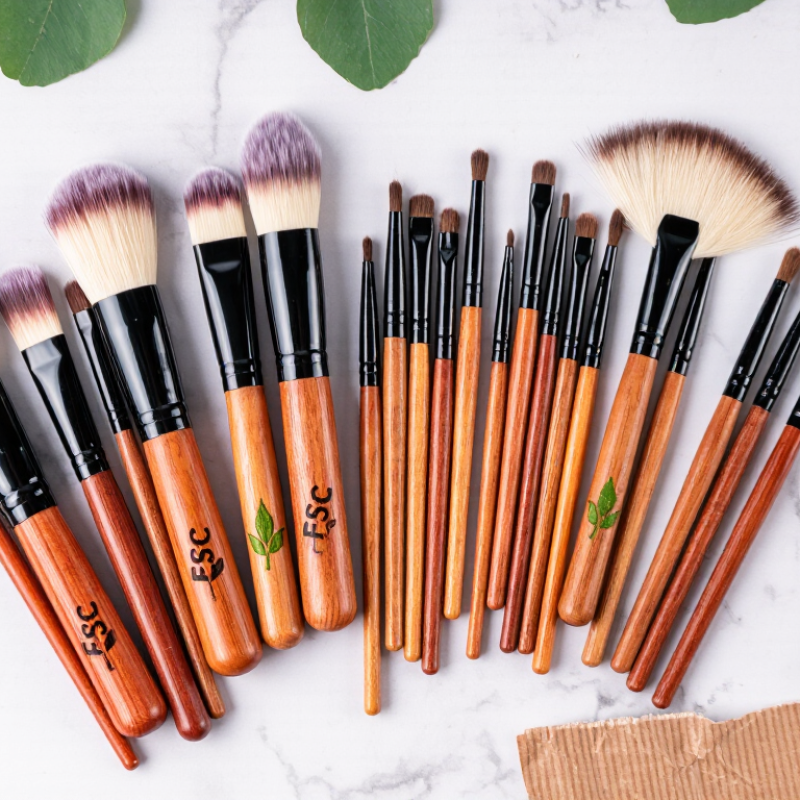
FSC certification links wood to forests managed under defined environmental and social standards. For a wooden makeup brush, it can help buyers trace the handle material through a documented chain of custody. That traceability matters. A smooth beech or bamboo handle may look reassuring, but appearance alone cannot confirm where its wood came from.
Check what the certificate actually covers. It may apply to the wooden handle, rather than the bristles, ferrule, or complete brush. FSC claims also use different categories, such as FSC 100%, FSC Mix, and FSC Recycled. Ask suppliers for a current certificate code, confirm its scope, and match the product claim to transaction documents. Small details count. A valid certificate for packaging does not automatically certify the handle.
Certification is useful evidence, not a promise of perfect sustainability or product quality. It does not tell you whether a handle resists swelling after repeated washing, for example. Request a sample, inspect the grain and finish, and ask how the wood is protected from moisture. Even careful checks leave some uncertainty. That is worth acknowledging, rather than treating a label as the whole story.
Start with scope, not a logo. Ask for the supplier’s valid Chain of Custody certificate number, legal entity name, site address, and product scope. Check the certificate in FSC’s public database. Then match its scope to the exact wooden brush handle and purchase documents. Bristles, ferrules, and packaging may have different material claims. That distinction is easy to miss.
FSC’s 2024 Facts & Figures reported more than 160 million hectares of certified forest across over 80 countries. This shows the system’s global reach, but forest coverage alone does not verify a particular brush. Request invoices, batch records, and material specifications that support the product claim. Compare them with a physical sample: look for consistent wood descriptions and clear product coding. A neat certificate file is useful, but it is not the whole audit trail.
Tips: Confirm certificate status before ordering and again before repeat purchases. Ask who controls records at each production site. Keep dated copies of checks and approvals. If a supplier cannot explain a mismatch, pause the claim review; sometimes the paperwork is simply incomplete, but that still deserves attention.
Leading FSC-certified wooden makeup brush suppliers offer more than a polished product sheet. They can identify the wood species, handle finish, ferrule material, and bristle type for each model. Ask whether FSC claims cover the wooden handle only or the complete product. Scope matters. A brush may combine certified wood with other materials outside that claim.
Reliable suppliers should provide a current certificate code and records linking certified material to finished goods. Check the certificate holder, status, and product scope in FSC’s public certificate database. Then compare those details with quotations, invoices, and sample labels. Paperwork should match the shipment. Request a sample and inspect its grain, coating, balance, and smooth edges. Check carefully. Small defects can become obvious with repeated use.
Production questions reveal practical competence. Ask how suppliers control wood moisture, maintain consistent handle dimensions, and prevent coating from pooling near the ferrule. Clarify minimum order quantities, lead times, packaging, and how production changes are reported. A low quote can hide thin documentation or uneven finishing. That deserves scrutiny. Certificates do not guarantee brush performance, and no supplier is flawless. Keep an approved sample, written specifications, and batch records to check later deliveries against the original order.
A supplier’s product range is best judged by usable options, not a long catalogue. Check whether it offers different brush shapes, handle lengths, wood finishes, and bristle types. Ask for sample dimensions and finish specifications. A flat shader brush and a tapered blending brush require different assembly and quality checks. Small details matter.
Production capacity needs a closer look. Request typical monthly output, minimum order quantities, sample lead times, and recent delivery estimates. Compare these figures with the number of styles in your order. A factory may quote high capacity, yet shared equipment or manual finishing can slow a mixed batch. Paper numbers are not the whole story. Ask how defects are recorded and how replacement units are handled.
For FSC claims, verify that the certificate is current and covers the relevant materials and activities. Do not assume a certified wood source automatically means every finished brush falls within the same scope. Request documentation alongside product samples, then compare handle consistency, ferrule alignment, and bristle shedding. One weakness in many comparisons is relying on a single sample; batch variation may only appear in a larger production run.
No supplier-specific product-range or production-capacity figures were provided for verification. The chart shows the share of those comparison dimensions supported by verified figures in the supplied information—not supplier capability. FSC certification relates to responsible material sourcing and chain of custody; it does not by itself establish a supplier’s range or production capacity.
For global buyers, a supplier’s FSC certificate is a starting point, not proof that every brush is certified. Ask for the certificate number and verify its current status, company name, and product scope in the official FSC certificate database. Check whether the scope covers the wooden handles and whether the finished product can carry the claim. Request transaction documents that connect the certified material to your order. A polished PDF is not enough.
Review the supplier’s quality process as well. Ask how wood species, coatings, and moisture are checked, then compare the answers with a physical sample. Look closely at handle joints, surface finish, and bristle attachment. Confirm that packaging and shipping documents use consistent product descriptions. Discuss lead time, minimum order quantities, and how defects are handled. I would not rely on a sample alone; production batches can vary, and that deserves a clear inspection plan.
Tips: Keep copies of certificates and order records. Ask direct questions. If an answer is vague, pause and verify it before placing a large order.
| Evaluation dimension | What to look for | How to verify | Buyer selection signal |
|---|---|---|---|
| FSC chain-of-custody status | A current FSC chain-of-custody certificate covering the relevant manufacturing or trading activity and product scope. | Request the certificate code and legal entity name. Check the certificate’s status, scope, and certificate holder in the FSC public certificate search. | The certificate is valid and its scope is relevant to the supplier’s role in the order. |
| FSC claim on the product | A clearly stated claim, such as FSC 100%, FSC Mix, or FSC Recycled, that matches the product documentation and authorized labeling. | Ask for the quotation, order documents, and label artwork to show the applicable FSC claim. Confirm that product labeling is authorized under FSC trademark requirements. | The claim is documented consistently; FSC certification is not assumed to mean every component is FSC-certified. |
| Wood species and origin records | The handle’s wood species, material description, and traceability information are disclosed and consistent across documents. | Compare the material specification, purchase records, and product description. For applicable shipments, check import documentation and relevant timber-trade requirements. | The supplier can identify the wood material and provide records supporting the stated sourcing information. |
| Brush construction and specifications | Written specifications for handle dimensions, finish, ferrule material, bristle type, assembly, and acceptable appearance limits. | Review a signed specification sheet and pre-production sample. Check dimensions, finish consistency, shedding, ferrule attachment, and handle smoothness against agreed criteria. | Samples and production inspection criteria are agreed before bulk production. |
| Chemical and material compliance | Material and chemical information appropriate to the destination market and the brush’s intended use. | Request relevant material declarations and test reports. Confirm that reports identify the tested material or product, test method, date, and issuing laboratory; assess applicable market rules with an importer or compliance specialist. | Evidence is product- and market-relevant rather than a generic certificate unrelated to the order. |
| Quality control and inspection | Documented incoming-material checks, in-process controls, and final inspection procedures for brush orders. | Request the inspection checklist and sample inspection records. Agree on defect definitions, sampling plan, packaging checks, and corrective-action process before shipment. | Inspection criteria are measurable, recorded, and linked to the approved sample. |
| Capacity and order terms | A written quotation that specifies the order quantity, unit price, tooling or setup costs, production schedule, and delivery terms. | Ask the supplier to confirm each term in writing for the exact brush specification. Clarify Incoterms® rules, shipment responsibility, payment milestones, and what may change lead time. | Commercial terms are complete and comparable across quotations; no unstated capacity or delivery claims are relied upon. |
| Packaging and transport protection | Packaging suited to protect handles, bristles, and printed components during storage and international transport. | Review packaging samples and carton specifications. Confirm protection against compression, moisture, and movement, and verify shipping marks and packing-list details. | Packaging is approved before production and matches the agreed shipment configuration. |
| Supplier identity and records | The contracting entity, production location, invoice details, and certificate holder are clearly identified. | Compare the contract, invoice, business registration details, production-site information, and FSC certificate record. Ask the supplier to explain any differences in entity names or roles. | The parties and responsibilities in the order are transparent and documented. |
Buyer note: FSC certification verifies forest-product chain-of-custody claims within the certificate’s scope; it does not by itself verify brush performance, chemical safety, or compliance with every destination-market requirement.
It can help trace the wooden handle through documented records. It may not cover the bristles, ferrule, or packaging. Looks can mislead.
Check its current status, company name, site address, and product scope in the public certificate database. Match these details to the exact handle and order documents.
No. A certificate may cover packaging only. Confirm that its scope includes the wooden handle. Small details matter.
Ask for transaction records, invoices, batch details, and material specifications. These should connect the certified wood to your order, not just show a polished certificate file.
No. It does not prove that a handle resists swelling or that bristles stay attached. Inspect a sample and check its finish, joints, and grain.
Look for an even surface, secure bristle attachment, and clear wood descriptions. Ask how the handle is protected from moisture. A sample is useful, but batches can vary.
Pause the product claim and ask for an explanation. Records may be incomplete, but that still needs attention. Don’t guess.
Recheck certificate status before ordering again. Keep dated copies of approvals and order records. Agree on batch inspections, lead times, minimum quantities, and defect handling before a large purchase.
FSC Certified Wooden Makeup Brushes combine practical beauty-tool design with responsibly sourced wooden handles. FSC certification indicates that the wood comes from forests managed according to recognized environmental and social standards, but buyers should still check that a supplier’s certification is valid and relevant to the products offered. A careful evaluation also considers brush materials, workmanship, quality-control procedures, customization options, communication, and the supplier’s ability to provide clear product and sourcing documentation.
Suppliers can differ widely in their brush styles, handle and bristle choices, minimum order quantities, lead times, and production capacity. Global buyers should compare these details against their market needs rather than relying on product range or quoted price alone. Before selecting a supplier, verify certification through appropriate documentation, request samples, confirm production and packaging specifications, and discuss order timelines and quality expectations. This process helps buyers make an informed choice and build a dependable supply relationship.